We’ve provided several answers to questions related to CNC Vacuum Table Vacs , see some other helpful Q&A related to this product.
-
Question: Why is port/connector size an important consideration for CNC vacuum table vacs?
Answer: The size of ports and connectors affects vacuum efficiency, compatibility with hoses and pumps, and ease of installation. Larger ports can allow for greater airflow and faster evacuation, while standardized quick-connect fittings simplify setup and maintenance. Products like the AirWeights Complete System 24 x 24 and AirWeights Vacuum Pump - 9 CFM come with quick disconnect fittings and multiple ports, offering flexibility for different hose sizes and configurations. This variety ensures users can find a cnc vacuum table system that integrates seamlessly with their existing setup.
-
Question: What are the best application/use cases for CNC vacuum table vacs?
Answer: The best CNC vacuum table vacs are those that match your specific application—whether it’s spoilboard use, fixture plate holding, or zoning for batch production. Spoilboards, like the AirWeights MDF Spoilboard - Single, are ideal for full-depth cutting and table protection, while reconfigurable gasket grids in systems like the AirWeights Complete System 24 x 24 and AirWeights Complete System 24 x 48 enable flexible workholding for various part shapes and batch sizes. With diverse options available, users can select the right system for anything from rapid prototyping to high-volume production.
-
Question: What are the benefits of different material constructions (e.g., steel, MDF, ABS, foam) for CNC vacuum table vacs?
Answer: The material construction of a vacuum table affects its durability, surface quality, and suitability for specific applications. Steel and ABS offer robust, long-lasting performance, while high-density MDF is often used as a spoilboard, allowing vacuum to pull through for versatile hold-down and easy part cutting. For example, the AirWeights MDF Spoilboard - Single is designed for use with AirWeights tables, adding a sacrificial layer that protects the table and enables full-depth cuts. By offering a selection of materials, users can optimize their setup for either heavy-duty industrial use or customizable, cost-effective workflows.
-
Question: Why are included accessories (like inline filters) important when buying a CNC vacuum table vac?
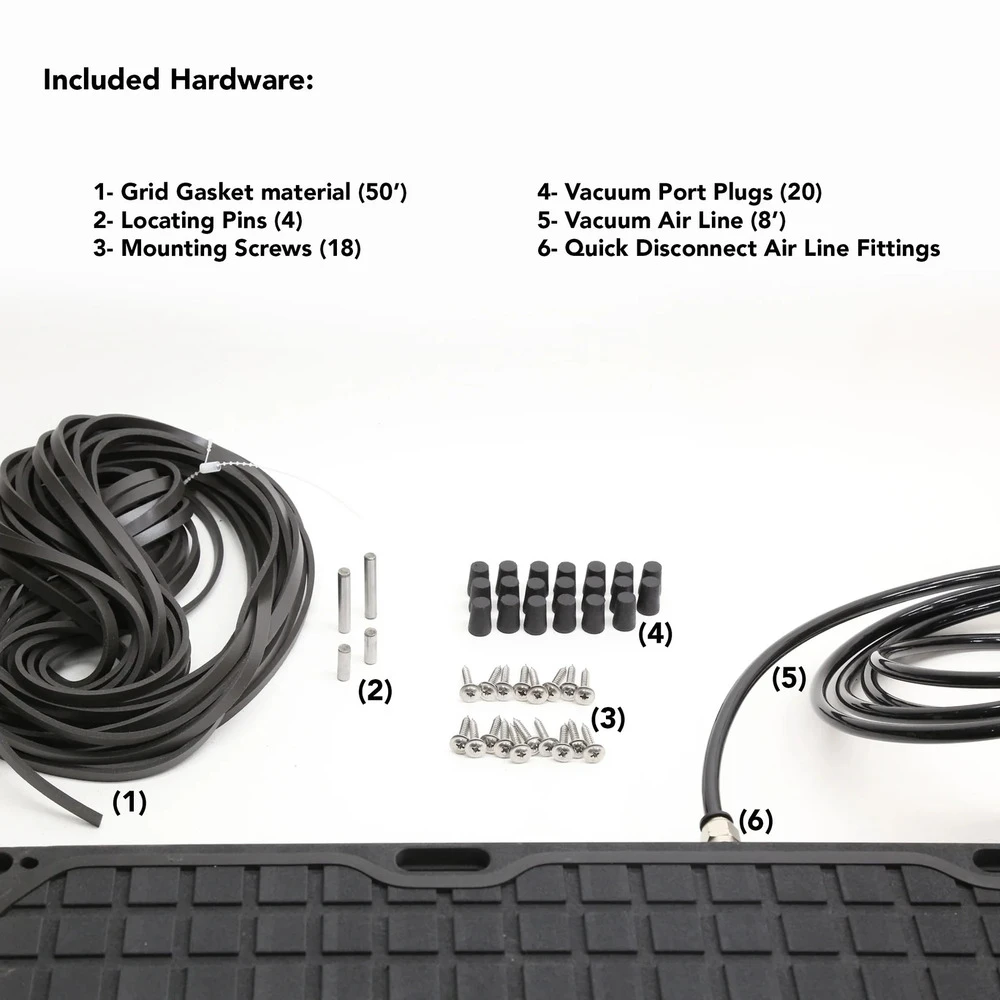
Answer: Included accessories such as inline filters, pressure gauges, mufflers, and quick disconnect fittings enhance the user experience by protecting the cnc vacuum table, simplifying setup, and improving maintenance. An inline filter, for example, keeps debris from entering the vacuum pump, extending its lifespan and ensuring consistent performance. Kits like the AirWeights Complete System 24 x 24 and AirWeights Complete System 24 x 48 include comprehensive accessory sets, making them ready to use out of the box. With a variety of options available, buyers can select systems with the accessory bundles that best suit their workflow and maintenance preferences.
-
Question: How do the dimensions (size of mat or plate) impact CNC vacuum table vac selection?
Answer: The size of the vacuum table or mat determines the maximum workpiece size you can securely hold, affecting both productivity and versatility. Larger tables accommodate bigger panels or multiple smaller parts in one setup, while smaller tables suit compact machines or limited workspace. For example, the AirWeights Complete System 16 x 16 is ideal for smaller jobs or benchtop CNCs, while the AirWeights Complete System 24 x 48 is perfect for larger sheets or batch processing. Multiple size options across the AirWeights range ensure users can find the perfect fit for their CNC machine and application.
-
Question: What are the best power requirements to look for in CNC Vacuum Table Vacs?
Answer: Power requirements, including voltage, amperage, and phase, are crucial when selecting a CNC Vacuum Table Vac because they determine compatibility with your shop’s electrical infrastructure and affect the pump’s performance and efficiency. The most common setups are single-phase, 120VAC systems that are easy to plug into standard outlets and consume moderate amperage, making installation simple for most users. For example, the AirWeights Complete System 24 x 24 and the AirWeights Vacuum Pump - 5 CFM both run on 120VAC with low amp draws, making them accessible for small to medium workshops. Meanwhile, higher CFM systems like the AirWeights Vacuum Pump - 9 CFM require higher amperage, offering more power for larger tables. This range ensures you can choose a product that fits your facility’s capabilities and production needs.
-
Question: How does the number of motors in a CNC vacuum table vac impact performance?
Answer: The number of motors in a CNC vacuum table vac affects suction power, redundancy, and operational flexibility. More motors can mean higher overall vacuum capacity and improved reliability since the system can continue operating even if one motor fails. However, many compact and efficient systems, like the AirWeights line, use a single, well-designed motor to keep setups simple and maintenance low, while still delivering impressive holding force. For example, both the AirWeights Complete System 16 x 16 and AirWeights Complete System 24 x 48 use single-motor pumps with different CFM ratings, balancing efficiency and power for various table sizes. Multiple options are available so users can select the right configuration for their workload and redundancy preferences.
-
Question: Why is maximum vacuum pressure (inHg) an important specification for CNC vacuum table vacs?
Answer: Maximum vacuum pressure, measured in inches of mercury (inHg), directly impacts the holding force the vacuum table can apply to your workpiece. A higher vacuum pressure means stronger and more reliable workholding, especially for dense or heavy materials. Most CNC vacuum tables target high vacuum pressures (often approaching atmospheric pressure, around 29 inHg) to ensure materials stay firmly in place. Products like the AirWeights Complete System 24 x 24 and AirWeights Vacuum Pump - 5 CFM are designed to provide substantial holding power, supporting a wide range of applications. With various models available, users can find a solution that matches their material and part size requirements for optimal safety and precision.
-
Question: What is the best maximum airflow (CFM) for CNC vacuum table vacs?
Answer: Maximum airflow, measured in cubic feet per minute (CFM), determines how quickly a vacuum table can evacuate air and maintain suction, especially when holding porous materials or larger surfaces. Higher CFM is advantageous for larger tables or when frequent part changes demand rapid re-sealing. For instance, the AirWeights Vacuum Pump - 5 CFM is suitable for smaller or less porous applications, while the AirWeights Vacuum Pump - 9 CFM delivers increased airflow for larger tables like the AirWeights Complete System 24 x 48. Choosing the appropriate CFM ensures efficient operation and strong hold, with multiple options available to fit different project scales.
-
Question: What is the recommended table size compatibility for CNC vacuum table vacs?
Answer: Ensuring your vacuum table vac matches your CNC machine’s table size is essential for maximizing workholding efficiency and minimizing waste. The right fit means better suction distribution and fewer leaks, enhancing both performance and material yield. The AirWeights system offers a range of sizes, such as the AirWeights Complete System 16 x 16, AirWeights Complete System 24 x 24, and AirWeights Complete System 24 x 48, allowing users to select the best match for their machine bed and project needs. This flexibility ensures a tailored solution for hobbyists and professionals alike.
-
Question: What is a vacuum press table?
Answer: A vacuum press table is a work surface equipped with a built-in vacuum system that holds materials, such as wood, firmly in place during processes like cutting,. The vacuum creates suction through small holes on the table, preventing the material from shifting. This tool is commonly used in woodworking on Cnc machines. And excellent choice would be the AirWeight Complete System which comes in many sizes such as the AWS -2424 -SV1 .
-
Question: How do CNC vacuum tables work?
Answer: CNC vacuum tables use a vacuum pump to create suction through small holes or channels on the table’s surface, holding the workpiece firmly in place during machining. This allows for secure and precise cutting without the need for mechanical clamps, especially for thin or delicate materials. It allows a much better hold down system without the danger of snapping a bit on an edge clamp .
-
Question: What are the different types of vacuum tables?
Answer: There are several types of vacuum tables, including porous (plenum) vacuum tables, which use a perforated surface for even suction, and grid or channel vacuum tables, which use grooves or channels to direct suction to specific areas. Some vacuum tables are designed for specific applications, such as CNC machining, or woodworking, and may feature adjustable zones or modular surfaces.
The AirWeights System is a very versatile vacuum table system with many options.
-
Question: What size vacuum pump for CNC?
Answer: The size of vacuum pump needed for a CNC machine depends on the size of your vacuum table and the material being held. Generally, for small CNC routers, a pump with a flow rate of 5–10 CFM (cubic feet per minute) is sufficient, while larger machines may require 20 CFM or more. Always ensure the pump can maintain adequate vacuum pressure (typically 20–25 inHg) for your specific application.
-
Question: How does the vacuum system work?
Answer: A vacuum system works by removing air from a sealed space using a vacuum pump, creating a pressure lower than atmospheric pressure. This low-pressure environment is useful for various CNC applications , it holds your work piece solidly in place and doesn't allow any movement that would ruin the project .
-
Question: How does a vacuum table work?
Answer: A vacuum table works by using a pump to create suction through tiny holes or a porous surface, holding materials firmly in place on the table. This suction prevents movement during CNC processes like cutting, engraving ensuring precision and stability.
-
Question: How many cfm for a vacuum table?
Answer: The required CFM (cubic feet per minute) for a vacuum table depends on the size of the table and the porosity of the material being held. Generally, small vacuum tables may require 5–20 CFM, while larger or more porous surfaces can need 50 CFM or more. It’s important to match the vacuum pump’s CFM to your table’s leak rate and application needs.